Your Win Rate Problem Is Their Buying Problem
Your win rate is not dropping because your AEs and SEs have lost their edge, but because the decision your buyers are trying to make has gotten harder, and your team's approach to discovery has not kept up.


Multiple ripple systems, meeting and interfering.
The pattern CROs are describing
“Our win rates keep slipping, Nikhil. And our deal cycles are getting longer. It's really tough to maintain an accurate forecast.”
And every CRO is tempted to reach for the same levers. More pipeline. Better demos. Doubling down on ROI.
The 2026 Pavilion and Fullcast GTM Benchmark puts numbers to the problem. Sales efficiency fell 28% in a single year. That decline decomposes into three parts: average deal value down 11.1%, win rate down 13.5%, and sales cycles 6.9% longer. In the same dataset, 78.3% of sellers missed quota.
Read that breakdown again, because it reframes the whole conversation. Win rate is one of three factors moving against you at once. A leader who fixates on win rate in isolation is trying to fix a third of the problem.
It is tempting to treat these as three separate issues. I think they move together because they share a single cause, and the rest of this piece is the case for why that cause sits outside the seller.
What has changed is not just the discipline of selling. What has changed is the difficulty of buying.
01. Why win rates are dropping, and what the number is hiding
Before you can fix a win rate problem, you have to see it clearly.
Win rate is the percentage of qualified opportunities that convert to closed-won deals. Close rate is broader. It counts every lead that entered the pipeline. Most sales leaders conflate the two, and the conflation hides where the loss is happening.
One measurement trap matters more than the rest. If you exclude "no decision" outcomes from the denominator, your reported win rate can look meaningfully higher than the reality your pipeline is delivering. Buyer inaction is where a large share of modern losses live. Exclude it and you are measuring competitive wins while ignoring the deals that died from indecision, which is the category that has grown most.
So track two things separately. No-decision rate, which is diagnostic on its own, because a rising no-decision rate points to weak urgency or missing decision confidence inside the buying committee. And stage-specific conversion, which tells you exactly where deals die.
The efficiency decomposition above is the reason this precision matters. If win rate is only one of three compounding factors, then the instinct to run a win-rate improvement program in isolation is already a misdiagnosis. The more useful question is what single condition is dragging all three numbers down at once.
02. The buying problem, not a sales problem
Buying committees are not simply evaluating products from multiple vendors. They are making a business decision under risk. The product is one input in that decision. The internal cost of getting it wrong is the dominant input.
Gartner's map of the B2B buying journey shows why this is so hard for a seller to influence from the outside.
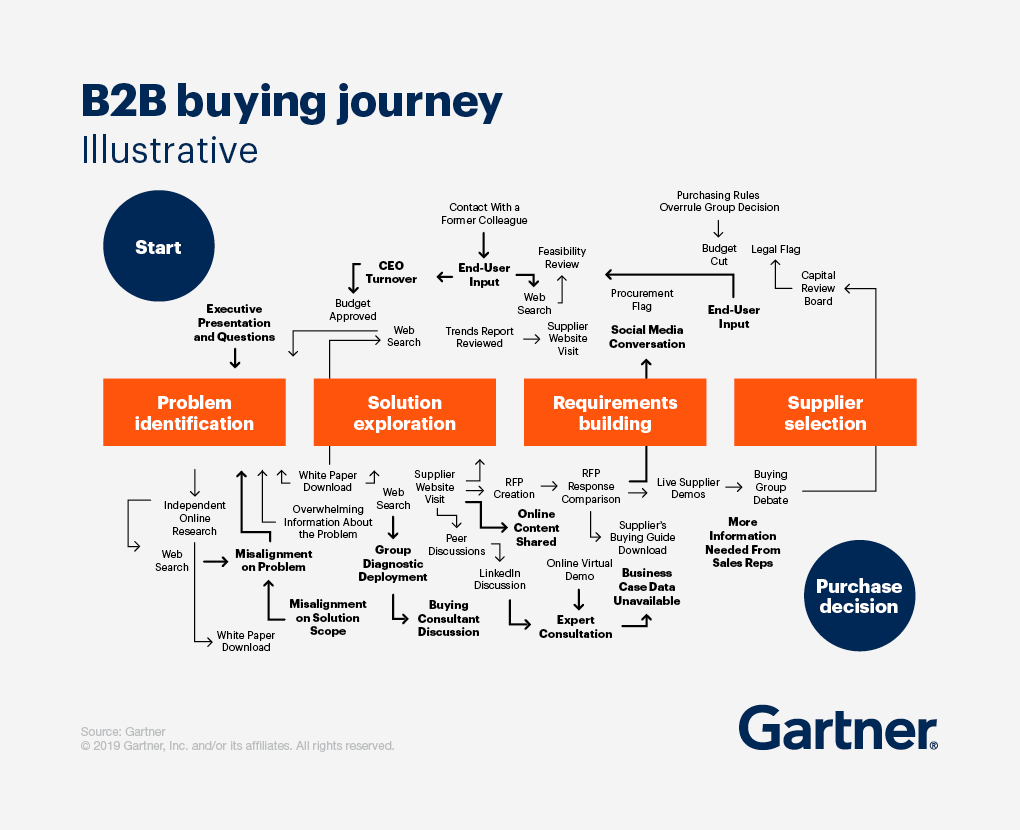
This diagram illustrates misalignment
- Misalignment on the problem.
- Misalignment on solution scope.
This changes what buyers need from a seller. They need to be able to:
- Justify the decision to people who were not in the room with you.
- Defend the decision to people whose budgets you are competing against.
- Operate the decision once procurement and finance have moved on.
The winning approach to discovery puts the focus on enabling decision confidence, i.e. the buying group's shared ability to make, defend, and carry through a decision.
I have written separately about why enterprise deals stall at the finish line and how to unstick them. That post treats the diagnosis at the level of a single deal. This post addresses the pattern at the level of how your team runs discovery.
03. Three signals your discovery is inadequate
Benchmark reports merely reinforce what you know is happening in your team. Here are three signals you recognize.
1. Deals are dying at consensus.
Your AEs are building champions. Your SEs are running demos. You are securing verbal commitments. And yet the deals are slipping out the back of the quarter - not because your champion said ‘no’ or that they've decided to go with another vendor, but because the committee could not agree on a ‘yes’. A decade ago, "no decision" was a nuisance category. Today it is the primary competitor.
2. Forecast confidence is decoupling from activity.
Activity metrics look healthy. Win rates do not. Your AEs and SEs are doing the work and the dashboards keep everyone happy during forecast meetings in the first 2 months of the quarter. And yet, the number at the end of the quarter still misses.
This is the tell of an approach where the things you can measure are no longer correlated with the outcomes you need. New dashboards will not fix it, because the measurement problem is downstream of the discovery problem.
3. AEs and SEs are telling different stories about the same deal.
Walk through a forecast with the AE and the SE, and you will often hear two different stories. The AE describes a strategic transformation. The SE describes a technical evaluation. Neither is wrong, but there is no convergence. This is one of the critical capabilities for aligning GTM teams that most orgs quietly lack: a shared account narrative that survives contact with the buyer.
Most AEs and SEs who have not been trained to see it do not even know it is happening.
The research is blunt about the scale of it.
Gartner found that 74% of B2B buying teams demonstrate unhealthy conflict during the decision process, meaning members with conflicting objectives, disagreements on the way forward, or decisions overruled from above (Gartner, May 2025). This is not friction you created. It is friction that was in the organization before you arrived.
It compounds because the decision you are asking for is, from the buyer's side, a change program they will be judged on. In a March 2025 Gartner survey of 980 global leaders, only 32% of mid-to-senior leaders delivered their last change initiative on time while maintaining engagement and performance.
So the committee is not weighing a purchase. They are weighing whether they can survive the change the purchase will entail, and most of them have watched a version of it fail before.
Which is why the deals slip, stall, or shrink massively (“let’s start small”). The Jolt Effect, from a study of 2.5 million sales conversations, found that between 40% and 60% of qualified deals are lost to no decision rather than to a competitor.
And the reason is a specific fear. As Dixon and McKenna put it, the reigning fear in a modern deal is not the fear of missing out, but the fear of messing up.
Once a buyer has settled on a direction, they switch from asking whether it will help them succeed to asking whether they can be sure it won't fail.
A buying committee already in conflict, already carrying the memory of one or more failed transformations, is a committee primed to choose the safety of 'no decision'.
None of this shows up in your pipeline review. Your AE and SE report a good deal. The committee, meanwhile, is debating if it is too risky to move.
That gap between what your team sees and what the buyer is actually doing is the most expensive one your MAP and forecasts are not covering.
04. Most teams never ran value discovery in the first place
When I start an engagement with my customers, the first thing I do is listen to their discovery calls. It is rarely as strong as the team believed. "But Nikhil, we already do discovery. Our AEs and SEs ask the prospect many questions."
True. And yet, many deals stall after a demo. So it is worth being precise about what value discovery actually is, because most of what gets called discovery is superficial.
Shallow discovery finds one department's pain. It locates a champion, surfaces their problem, confirms budget and timeline, and moves to a demo. It is single-threaded and single-department. It answers one question: does this person need what we sell?
It seeks to answer the question: can this organization agree that this is worth doing?
Gartner's buyer research shows why the difference is decisive, and why the shallow version is weak and actively backfires.
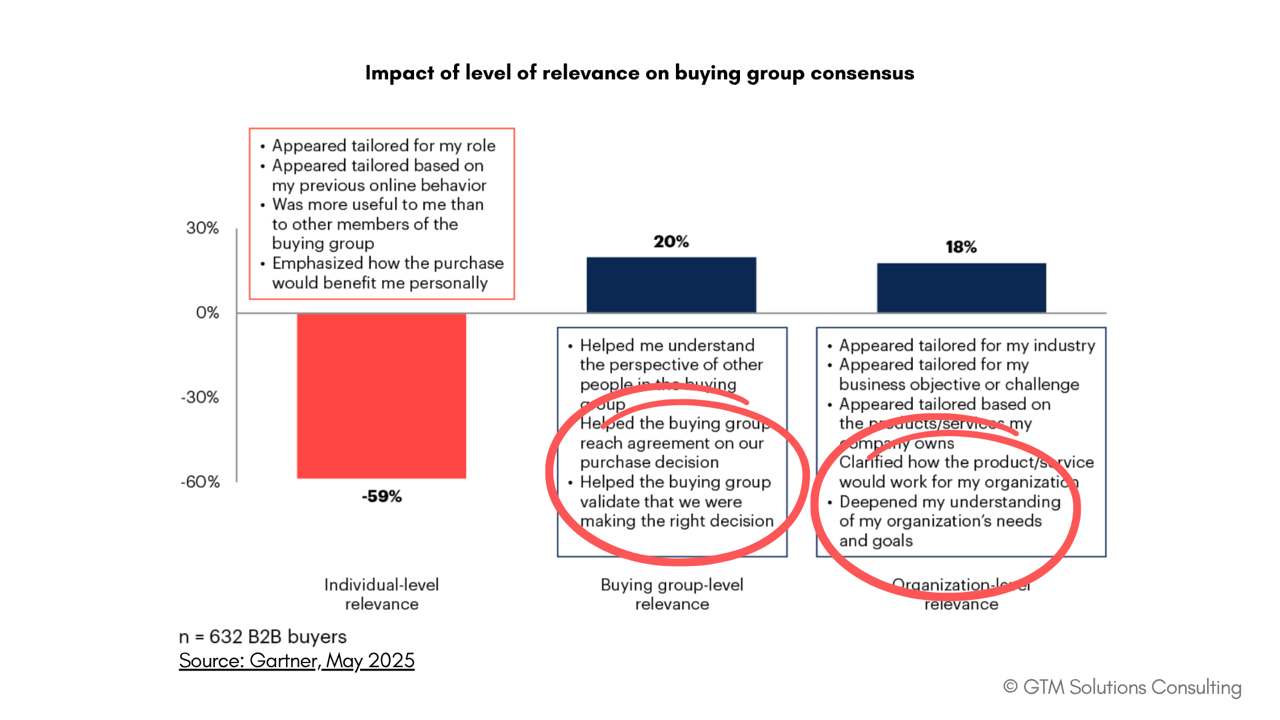
Let's take a close look at the left-hand bar. When you tailor your case to a single person's private win, you do not just fail to help the group. You reduce its ability to agree, by 59%. That is the signature of shallow discovery. It is single-threaded relevance, and the data says it works against the very consensus you need.
The two bars on the right are strong discovery, or value discovery, expressed as an outcome. Relevance to the group, and relevance to the organization, drive consensus.
This is the strongest argument for running it properly, across levels and across departments, rather than stopping at the first person who says yes.
So the question is how to run discovery that reaches the whole decision. Three things make that possible, and each answers a problem this post has already put in front of you.
The Three-Level Stakeholder Model gives discovery its coverage.
The consensus problem is a coverage problem. Value discovery has to connect the operational, managerial, and executive tiers of the buying committee, because a decision is only defensible when operational pain, managerial KPIs, and executive priorities line up.
The operational tier answers "how does this change our work?" The managerial tier answers "which of our performance targets does this improve?" The executive tier answers "why does this deserve funding now, against everything else on the table?"
The Compass Questioning Model gives discovery its reach.
Coverage is the goal. Reaching it takes questions that move in every direction across the account, not just deeper into one contact. Toward executive priorities, and towards operational reality. Towards quantifying the current state and the future state.
The non-linear buying journey in that first Gartner diagram is exactly the terrain this is built to cross. Most reps question in one direction and call it discovery. Value discovery is much more profound.
Financial Fluency makes the decision defensible.
A champion cannot defend a decision they cannot cost. Financial Fluency is the ability to translate an operational problem into the CFO-level metric it moves, so the business case travels into rooms you will never enter. If procurement is the first time price comes up, the leverage is already gone.
These three components are not a checklist to hand a rep. They are skills, and like any skill they are learned through deliberate practice and coaching, not absorbed from a one-page framework or a single kickoff session.
That is the work. It is also exactly the work most enablement skips, which is why strong value discovery is rare even in teams that understand the theory.
05. A 30-minute diagnostic you can run this week
Ask your team to run this before your next forecast call.
- Pull three lost deals from last quarter. Ideally ones that ended in "no decision" rather than a competitive loss.
- For each deal, list every stakeholder you engaged. Sort them into three tiers. Operational: the users of the solution. Managerial: the owners of the performance targets it improves. Executive: the owners of the strategic priority those targets support.
- Ask two questions per deal. Which tier did you cover well? Which tier did you never reach?
- Write the answer on one line per deal.
In most engagements I have run, the pattern is consistent across all three deals. The operational tier is covered thoroughly. The managerial tier is covered partially.
That gap is not incidental. The executive tier is where the questions "why should we fund this now?” and "can we actually implement this change?" actually get answered. Skip it, and the FOMU never gets addressed, only avoided. That is why the deal does not die at no. It dies at “not yet.”
If this pattern shows up in your three deals, you have your diagnosis. The rest of the work has a place to start.
06. In closing
Every CRO I work with eventually asks the same question in some form. What will move win rates back up? The answer is not a new tool. It is value discovery done properly. Discovery that assumes buying is now the hard part, and reaches across the committee to connect operational pain, managerial KPIs, and executive priorities into a decision the group can defend together.
That is what a Value Discovery practice builds toward.
If the pattern in this post describes your team, we should talk. My work is helping revenue teams make value discovery the default, so that decision confidence stops being something you hope your champion has, and becomes something you build across the committee on purpose.
Related reading: AI Adoption in Presales Is a Design Problem.
Ready to apply this?
Book a diagnostic conversation.
Related essays.

What Government Buyers Are Actually Buying
Government technology procurement decisions are made at the intersection of mission, political relevance, administrative defensibility, and institutional continuity. Vendors win when they help these interests converge while reducing the personal and institutional exposure.
AI Adoption in Presales Is a Design Problem
AI adoption in presales fails when it automates broken workflows rather than redesigns the role itself. The highest-leverage question is not what to automate, but what to stop. And the answer has to be built with the team, not communicated to them.

Customer Indecision: Why Your Enterprise Deals Stall, and How to Unstick Them
Deals stall when your champion cannot make that case in a room you are not in. Most stalls are both a value clarity problem and an organizational one, and you diagnose them by reading 3 stakeholder levels: operational, managerial, executive.