AI Adoption in Presales Is a Design Problem
AI adoption in presales fails when it automates broken workflows rather than redesigns the role itself. The highest-leverage question is not what to automate, but what to stop. And the answer has to be built with the team, not communicated to them.


01. The System Needs a Redesign
Ask any Sales Engineer what their week looks like, and they will describe something like this: a morning spent hunting for the right slide deck, an afternoon documenting a call no one will read, and somewhere in between, an actual customer conversation that reminded them why they took this job.
The 80/20 rule has been inverted. In many presales organizations, SEs spend most of their time on work peripheral to the role: synthesis of notes, admin, internal coordination, deck-hunting, proposal formatting. The actual job - earning the trust of a skeptical buyer, understanding a complex problem, building a point of view that makes a customer feel understood - gets whatever time remains.
This is a systems problem, and its consequences show up directly in customer conversations that stay one level too shallow.
Feature lists, demo scripts, and generic value propositions replace an informed point of view.
Most organizations are now running some version of an AI-adoption initiative. The pattern is consistent: automation bolted onto workflows that were already broken. Automating a broken process does not create transformation. It creates a faster broken process.
02. Redesign the Role, Not Just the Workflow
The more important question is not "what should we automate?" but "how should we be working?" That is not a technology question. It is a design question.
Redefine the SE's core job.
The goal is not to do the same things faster. The prize is recovering hours lost to noise and redirecting them toward work only a human can do well: reading a room, earning trust, asking the question that opens a conversation.
AI handles research synthesis, documentation, and internal coordination. The SE invests that recovered capacity in understanding the customer more deeply before the meeting begins.
Start with subtraction.
Most AI rollouts begin by asking what the team should start doing. The better question is what it should stop doing.
In a March 2025 Gartner survey1 of 980 global leaders, only 32% of mid-to-senior leaders delivered their last change initiative on time while maintaining engagement and performance.
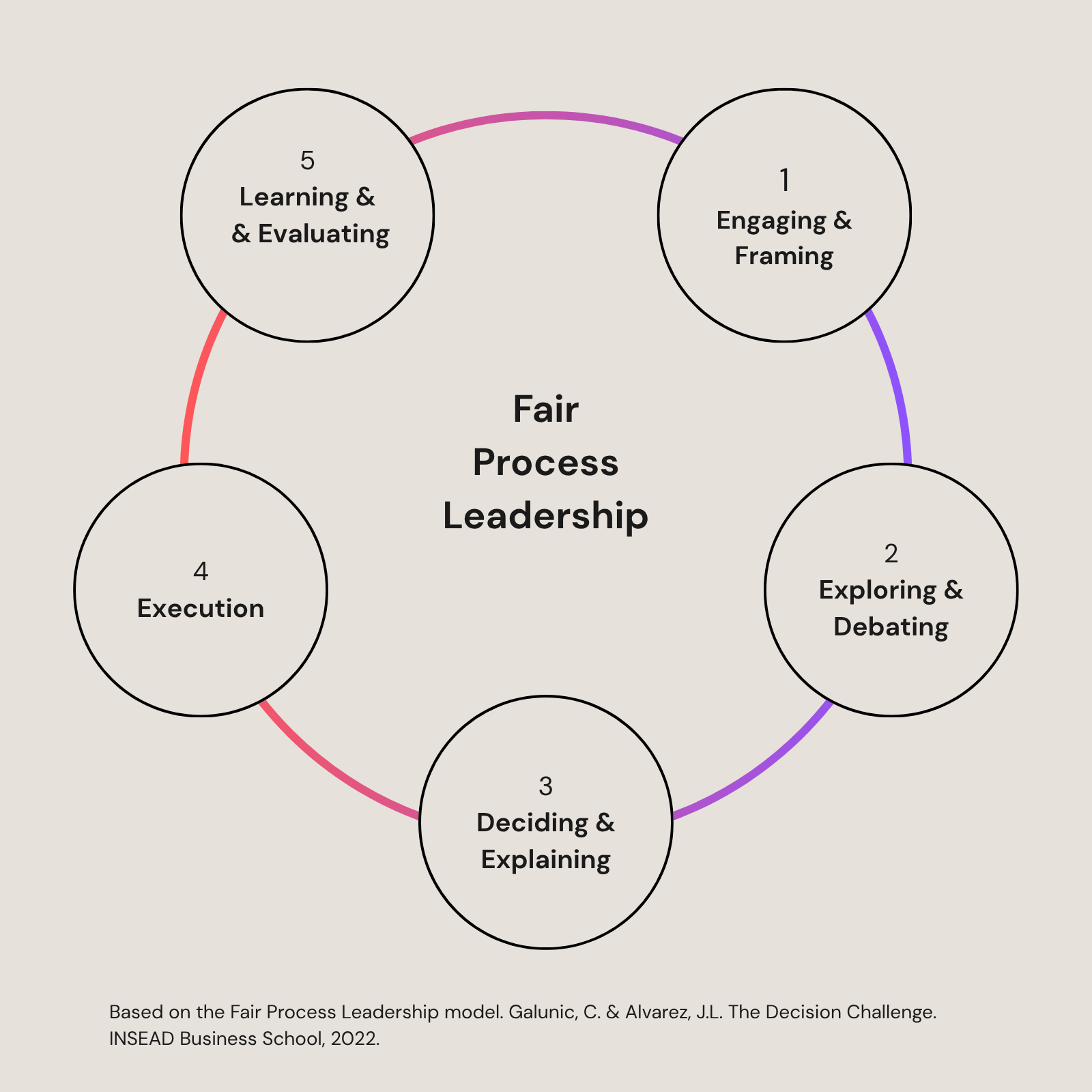
INSEAD's Fair Process Leadership2 (FPL) model was built to close that gap. It starts with the Engaging & Framing step: before any solution is proposed, the problem is examined together. Which tasks consume disproportionate time? Which internal processes interrupt meaningful customer work? The team invests in ownership of the change when it builds that picture together.
Commit to eliminating, simplifying, or automating that work before adding new expectations. If the team's calendar is already full, every new tool becomes additional overhead rather than relief. Space must be created before it can be used for better work.
Co-design the change.
This is where most initiatives fail. Leadership selects a workflow to improve, a vendor-selection process is concluded, a Slack announcement is made, and, weeks later, adoption is inconsistent and falling.
Gartner's April 2025 research1 found that 79% of employees do not trust their organization's ability to change effectively, with most believing past change decisions were poor and future ones unlikely to succeed. Change efforts often do not start from neutral sentiment but from justified skepticism.
The two middle stages of the FPL model address this. Exploring & Debating is where the leader encourages the widest range of ideas, including the ones that may cut against the original plan.
A team given real room here may conclude that AI is a partial answer, one that still depends on better context, cleaner data, or upstream workflows.
Deciding & Explaining is the stage where the leader shifts to telling. The decision is made, the trade-offs are named, and the paths not taken are explicitly closed. When people understand why an option was rejected, they stop relitigating it and commit to the one they've chosen.
Teams adopt a new way of working when they have helped shape the direction and understand the reasoning behind the final call. Leadership sets the constraints. The team designs the path.
On Build vs. Buy.
High-capability teams are increasingly tempted to vibe-code everything in-house. The maintenance cost of internal tooling compounds in ways that remain invisible until they are difficult to reverse.
For example, a competency rubric built around your own discovery methodology, or a solution document template drawing from institutional knowledge and successful wins is worth that kind of investment.
Build what makes your SE function distinct. Buy what does not.
Plan for uneven adoption.
The Execution stage of the FPL model asks the leader to stay visibly behind the decision long after the announcement, and to keep connecting each action back to a clear story, so the change reads as a coherent direction rather than a series of disjointed demands.
The tactics for the three groups will vary. Early adopters need autonomy and a mandate to test. Pragmatic users need frictionless defaults and visible time savings. Skeptics need evidence from colleagues whose judgment they trust, and proof that leadership has not quietly moved on to the next priority.
Map your team before you design your rollout.
03. What This Looks Like in Practice
Saurabh, then Senior Director of Solutions, led a presales transformation for a team of 20+ SEs at a high-growth Fintech selling to both traditional retail customers and global Enterprises. It began with a familiar condition: an SE team spending disproportionate time on internal work, struggling to develop a differentiated point of view for every deal.
Before touching any customer-facing workflow, the team built what became known as the "Get It Done Yourself" knowledge base: a structured internal resource giving SEs fast, reliable answers to questions they were currently hunting for manually. Unglamorous, but foundational. Until you stem the daily bleeding of time and energy to internal ambiguity, no upstream improvement sticks.
Using Claude on top of CRM data, the team moved toward near-automated first drafts of verticalized decks and briefs tailored to the prospect's sector. A designer entered the loop only for senior executive meetings where polish genuinely mattered. For everything else, the SE reviewed and refined a draft rather than starting from a blank slide. More importantly, the SE's energy moved earlier in the process: into understanding the customer before the meeting, rather than formatting slides after it.
On complex deals, solution documents could consume the majority of an SE's time. A Mermaid-based plug-in generated flow diagrams from structured inputs, combined with templated solution-document creation using call notes and CRM data. A multi-day task became a review-and-approve workflow. This gave SEs back attention at the point in the deal cycle where customer understanding mattered most.
Call transcripts were scored against a competency rubric for targeted skill development, not surveillance. Where data showed SEs consistently leading with product rather than discovery, that pattern informed the coaching curriculum. A byproduct emerged: a GTM signal layer revealing how often SEs discussed newly launched products and where discovery conversations were breaking down. The AI coaching infrastructure turned presales into a feedback loop for the broader go-to-market organization.
Early attempts to automate existing workflows without questioning them first produced marginal gains. The turning point came when the team stopped asking "how do we automate this?" and started asking "should this exist at all?"
04. What Leaders Should Pay Attention To
Technology is no longer the primary constraint. Current AI capabilities are sufficient for the research, synthesis, documentation, and coordination work that absorbs presales capacity. The bottleneck is the conversation leadership teams are avoiding:
That conversation is uncomfortable because it requires challenging inherited assumptions about how time is allocated, what gets measured, and which activities truly create customer value. Tool selection is easier. Adoption metrics are easier. Neither is sufficient.
Two conditions are necessary, and neither works alone. Grassroots momentum matters: without enthusiasts who demonstrate real improvement, the initiative stalls at the evangelism stage. Leadership commitment matters equally: without structural change to how time is allocated and what gets measured, individual behavior change does not scale.
This is where the fifth stage of the FPL model - Learning & Evaluating - compounds benefits. AI adoption is not a project with an end date but a cycle, and each round only improves if the team honestly assesses what worked, what did not, and what has changed since the work began. When that assessment is candid, with credit given and failures owned, the team takes the next round more seriously. Skip it, and leaders signal the change was a one-off push rather than a new way of working.
That is where genuine redesign begins. Everything else is simply a faster version of what already exists.
The Authors
Written from experience building and scaling presales and post-sales functions across high-growth SaaS environments.
Saurabh Guru is Head of Customer Onboarding and Launch Advisory at Adobe. He has spent 19 years building and scaling presales, solutions engineering, and post-sales functions across high-growth SaaS companies.
Nikhil Sarma is the founder of GTM Solutions Consulting and has previously led Solutions Engineering and Sales teams across high-growth SaaS companies. He coaches revenue teams on a buyer-centric approach to value discovery, storytelling, and negotiation.
References
1. Velnoskey, K., Laman, I. & Valencia, C. (2026). Why Keeping Up with Change Feels Harder Than Ever. Harvard Business Review, January 15, 2026. Drawing on Gartner research published in "Reinventing Change Leadership: Leading Through Never-Ending Change."
2. Galunic, C. & Alvarez, J.L. (2022). The Decision Challenge. INSEAD Business School. The Fair Process Leadership model referenced in this article draws on foundational research by Kim, W.C. & Mauborgne, R.A. (1998). Procedural Justice, Strategic Decision Making, and the Knowledge Economy. Strategic Management Journal, 19(4), 323-338, and Van der Heyden, L., Blondel, C. & Carlock, R.S. (2005). Fair Process: Striving for Justice in the Family Firm. Family Business Review, XVIII.
Ready to apply this?
Book a diagnostic conversation.
Related essays.

What Government Buyers Are Actually Buying
Government technology procurement decisions are made at the intersection of mission, political relevance, administrative defensibility, and institutional continuity. Vendors win when they help these interests converge while reducing the personal and institutional exposure.

Your Win Rate Problem Is Their Buying Problem
Your win rate is not dropping because your AEs and SEs have lost their edge, but because the decision your buyers are trying to make has gotten harder, and your team's approach to discovery has not kept up.

Customer Indecision: Why Your Enterprise Deals Stall, and How to Unstick Them
Deals stall when your champion cannot make that case in a room you are not in. Most stalls are both a value clarity problem and an organizational one, and you diagnose them by reading 3 stakeholder levels: operational, managerial, executive.