What Government Buyers Are Actually Buying
Government technology procurement decisions are made at the intersection of mission, political relevance, administrative defensibility, and institutional continuity. Vendors win when they help these interests converge while reducing the personal and institutional exposure.



Government technology is ultimately judged by whether it improves public outcomes for the people who depend on it.
01. The premise
We had spent three weeks preparing for a technical evaluation with Telangana's MeeSeva e-governance platform, the system that runs certificates, licenses, and permits for tens of millions of citizens in Telangana, India. Our team walked in ready to talk performance: query throughput, replication lag, benchmark numbers that made our database migration look inevitable. We assumed the fastest database would win the room.
It didn't. The committee's real concern turned out to be our rollback procedure if the migration failed on a weekday afternoon, and whether our audit trail would satisfy a state comptroller two years later.
That gap is worth examining, because it isn't unique to us.
Most vendors bring a familiar enterprise sales playbook optimized for the buyer's commercial growth to the government: find a champion, build the business case, move quickly, and refine through implementation. Those instincts still matter, but they are incomplete.
Government buyers must weigh cost, performance, and risk against mission delivery, public accountability, formal process, and the need for decisions to withstand scrutiny long after the original sponsors have moved on. Until vendors understand those incentives, even a strong solution can be framed around the wrong questions.
02. Two different games
The differences show up the moment you compare how each buyer moves. Enterprise buyers may have greater flexibility to align around a core group of decision-makers. Government tenders typically move through more formal stages, committees, and approval cycles.
Enterprise evaluations reward a strong TCO story and business case; government evaluation is compliance-first. Failing a mandatory certification, eligibility requirement, or data provision can remove a proposal from consideration before its broader value is assessed.
Enterprise buyers often retain more room to refine scope during the sales process. Once a government tender is published, meaningful changes usually require formal clarification or amendment.
And where an Enterprise champion might message you directly, a government sponsor places greater weight on formal communication, correct routing, documented decisions, and respect for administrative hierarchy.
None of this is a bureaucratic accident. It's a different set of incentives producing a different set of behaviors, and the incentives are worth naming directly.
Most enterprise sales frameworks define value through three outcomes: make money, save money, or reduce risk. Selling to the Government adds a fourth: advance the mission.
That mission may involve wider access to services, greater transparency, or a better citizen experience. Technology's role is to help the department deliver that outcome.
The purchase decision sits at the intersection of mission, political relevance, administrative defensibility, and institutional continuity.
Each stakeholder views it through a different lens. Political leaders want visible progress. Administrators need a lawful, feasible, supportable program. The Finance department and procurement committees must ensure that public funds are spent responsibly. Front-line teams need a system they can operate. Citizens experience whether the service has improved.
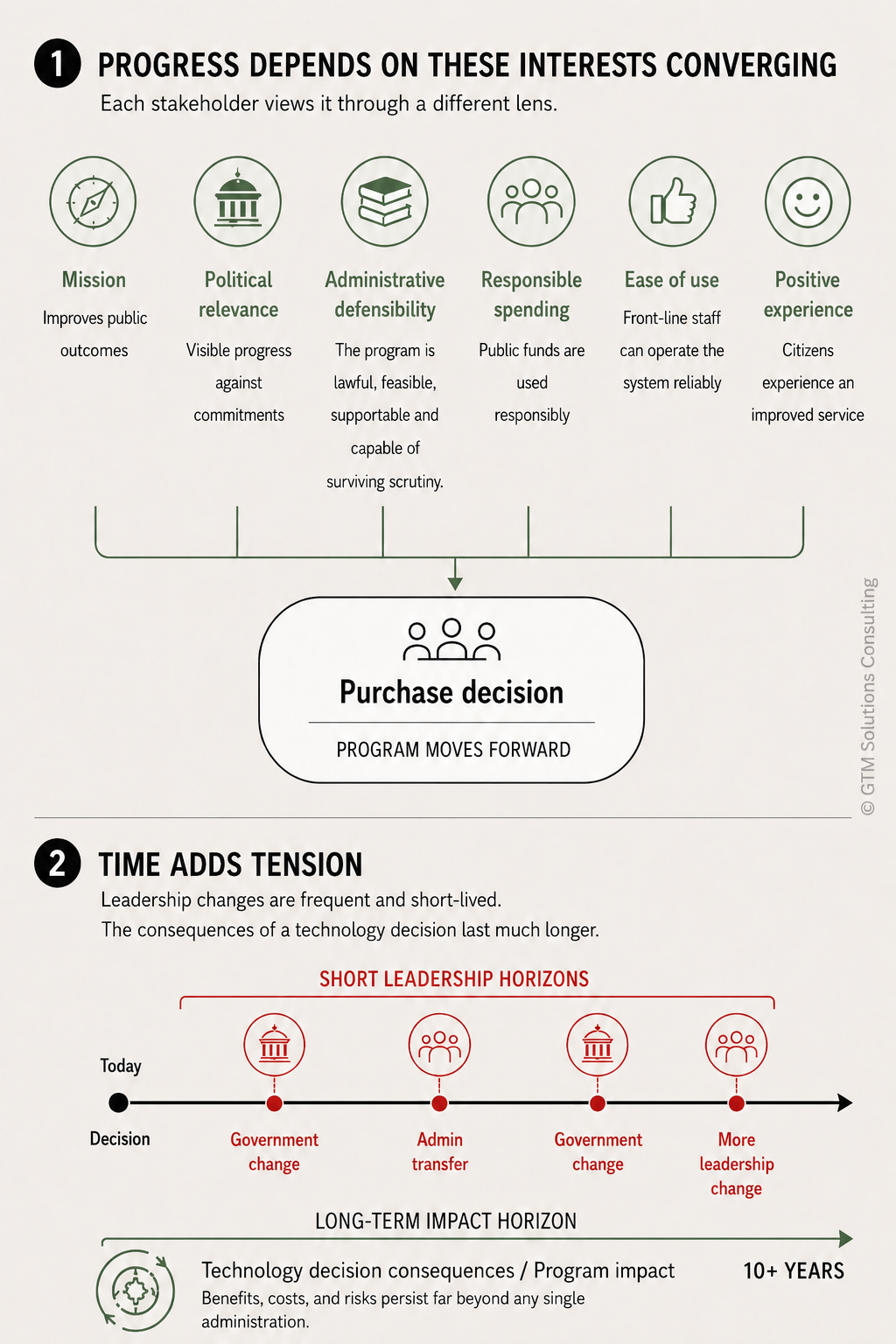
Progress depends on these interests converging. Political relevance can help. A program that improves public outcomes may also fulfill an electoral commitment and attract the sponsorship needed to fund and protect it.
Time adds another tension. Governments change, and senior administrators move to other departments. The consequences of a technology decision may remain for a decade or longer.
Vendors win when they help these interests converge while reducing the personal and institutional exposure associated with approving the purchase.
03. The stakeholders who aren't in the room
Once you understand what government buyers are optimizing for, the org chart starts to look misleading. On paper, a Secretary or Principal Secretary sits at the top and signs off on the deal, but you'll rarely meet them, and by the time a proposal reaches that desk, the real decisions are already made. The Director or Commissioner driving the initiative is your actual Project Champion/Sponsor. The Technical Evaluation Committee scores your proposal and knows the legacy system better than you ever will.
But the stakeholders who decide whether your project actually succeeds don't sit in any of these meetings - district officers who'll operate the system day-to-day, service-center staff processing hundreds of applications, citizens waiting for documents.
None of them has a formal vote in procurement, and yet together they can determine adoption.
04. Compliance is not a checkbox
That MeeSeva evaluation taught us something standard sales training doesn't cover:
GovTech buyers frequently optimize for risk reduction before they optimize for performance gains.
Vendors who treat compliance documentation as paperwork to get through are competing for the wrong prize.
Experienced enterprise technology sellers recognize that appealing to the Fear of Missing Out (FOMO), the concern that waiting will leave the organization behind, is rarely enough. They must also address the Fear of Messing Up (FOMU), the concern that acting may prove costly, disruptive, or difficult to reverse. In most organizations, FOMU can be at least as influential as FOMO, particularly as buyers approach a final decision1.
The consequences may take several forms. The project may fail to deliver its mission. Implementation may disrupt public services. The decision may attract political criticism, audit scrutiny, or public embarrassment. The officials involved may also face personal career consequences if the choice proves difficult to defend.
Government buying further accentuates an asymmetry present in any large private organization: the gains from success are widely shared, while responsibility for a failed or indefensible decision may remain traceable to those who approved it. This gives decision-makers a strong incentive to favor choices they can explain and defend later.
Buyers look for evidence that the solution can be implemented safely, reversed if necessary, and explained years later to people who were not part of the original decision.
For vendors, the implication is that a strong case for the upside is insufficient. The proposal must also reduce the exposure associated with acting: through phased delivery, clear governance, auditability, credible references, and a well-defined path back if the implementation fails.
05. A practical playbook
None of this makes GovTech deals unwinnable. It means winning requires a different approach.
Engage before the requirements harden. By the time a tender is published, vendors who attended pre-bid meetings and briefed the department informally already have a head start. Government buyers trust partners they've met, not vendors who show up cold.
Early conversations help vendors understand the mission, operational constraints, and interests shaping the purchase. They also help departments understand what the market can realistically deliver.
Once the tender is published, the scope and evaluation criteria leave far less room to reframe the problem.
Translate technology into operational assurances. Terms such as “SaaS” and “Agile” may create more questions than confidence in buyers who prefer terms such as “hosted solutions” and “phased delivery”. Explain where the system will be hosted, how data will be governed, how delivery will be phased, how milestones will be accepted, and how services will continue if implementation runs into difficulty.
Help each stakeholder defend the same decision. Connect the proposal to the mission while addressing political visibility, administrative feasibility, responsible spending, technical risk, and front-line usability. Comparable references, clear governance, an audit trail, and a credible rollback plan give stakeholders evidence they can carry into their own approval processes.
Respect the institution’s operating rhythm. Map formal authority, follow communication protocols, and document decisions. Build contingency for committee schedules, budget approvals, tender clarifications, elections, transfers, and competing departmental priorities. A rule of thumb is to budget three times the timeline you're given - when a government buyer says six months, plan for eighteen.
Make local fit explicit. Where the tender considers local content, Indian hosting, data arrangements, or local implementation capacity, state these clearly and support them with evidence. These factors contribute directly to the credibility and defensibility of the proposal.
If you're building or hosting locally, say so loudly. ‘Make in India’ preferences and data-localization requirements are a genuine differentiator, and not just compliance boilerplate.
06. Your Sales team's involvement doesn't end at the Purchase Order
In Enterprise sales, ownership after a Purchase Order is signed typically shifts to Customer Success, Professional Services, or an implementation partner. After a structured handover, the AE and SE step back until an escalation, renewal, or expansion brings them back into the account.
Government deals often demand greater continuity from the original sales team.
Implementation may expose ambiguities between the tender, the proposed solution, and operational reality. Requirements evolve, change requests emerge, and stakeholders may transfer or be replaced. The people who shaped the proposal often retain context that cannot be transferred through a handover call alone.
Presales and account teams may therefore remain involved well beyond contract signature, helping interpret commitments, rebuild alignment, manage expectations, and preserve confidence in the original decision.
This continuity matters because implementation determines whether the purchase delivers its mission and whether the officials who approved it can continue to defend it.
This is not a flaw in the process. It's a reflection of what's actually being bought.
Vendors who understand this from their earliest engagement will be better prepared than those who arrive with a benchmark deck and a champion strategy borrowed unchanged from enterprise sales.
07. Conclusion
The next time your team prepares for a government evaluation, look beyond your benchmark deck.
What mission must this purchase advance? Whose interests must converge for the decision to move forward? What political, administrative, and public scrutiny must it withstand? And what are the people involved most afraid of getting wrong?
References
- Matthew Dixon and Ted McKenna, The JOLT Effect: How High Performers Overcome Customer Indecision (Portfolio, 2022).
Authors
Hari Kiran is the Founder & CEO of OpenSource DB and a PostgreSQL community leader with over 20 years of database industry experience. He is the founder of Postgres Women India, Hyderabad PostgreSQL User Group, and Vizag PostgreSQL User Group, and serves as a PostgreSQL Code of Conduct Committee member. A regular speaker at PostgreSQL conferences, Hari is passionate about advancing open-source databases, mentoring professionals, and building inclusive technical communities. Prior to OpenSource DB, he held database leadership and SME roles at GE, Oracle, Optum, 2ndQuadrant, and EDB.
Nikhil Sarma is the founder of GTM Solutions Consulting and has previously led Solutions Engineering and Sales teams across high-growth SaaS companies. He coaches revenue teams on a buyer-centric approach to value discovery, storytelling, and negotiation.
Ready to apply this?
Book a diagnostic conversation.
Related essays.

Your Win Rate Problem Is Their Buying Problem
Your win rate is not dropping because your AEs and SEs have lost their edge, but because the decision your buyers are trying to make has gotten harder, and your team's approach to discovery has not kept up.
AI Adoption in Presales Is a Design Problem
AI adoption in presales fails when it automates broken workflows rather than redesigns the role itself. The highest-leverage question is not what to automate, but what to stop. And the answer has to be built with the team, not communicated to them.

Customer Indecision: Why Your Enterprise Deals Stall, and How to Unstick Them
Deals stall when your champion cannot make that case in a room you are not in. Most stalls are both a value clarity problem and an organizational one, and you diagnose them by reading 3 stakeholder levels: operational, managerial, executive.